Polar coordinates are not formally introduced in high school, yet sector area is required to prove fundamental trigonometric limits. Having already seen that proof, it wouldn’t be all that painful for students to see circle area derived through the limiting process as applied to angles.

Variable Angle Fixed Radius

Circle AreaPolar


I’ve included another scenario below, this time with variable radius as well.

Variable Angle, Variable Radius
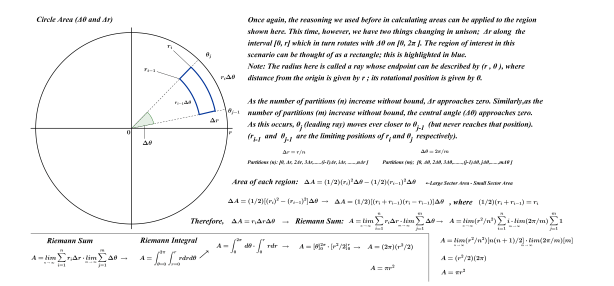
 

Circle AreaPolar(delta r)

Explore changing polar coordinates here.

Connect your understanding of polar coordinates to that of cylindrical coordinates.


Thanks for reading.

Displayed below are two familiar methods of determining volumes of solids, this time as applied to the sphere. It is beneficial to compare two (or more) methods of determining volumes of a given solid; this allows students to develop a deeper understanding of each process that might not otherwise occur if kept in isolation from one another. It is also beneficial to compare directly each method as applied to different shapes. I’m including a link to volume of cones here for that purpose.

Volume SphereShells

Volume of Sphere (slabs)

See also volume of cones.

Thanks for reading.
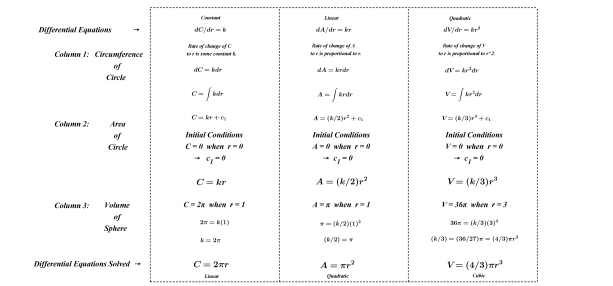
Having side-by-side comparisons can be valuable experience as similarities (and differences)  are more readily apparent; students can gain a deeper understanding of the nuances from one to the next. For example, its worth noting that the rate of change of a circle’s area with respect to its radius is equal to that circle’s circumference; a similar relationship exists between the volume and surface area of a sphere.

Investing some thought into these and other subtleties can go a long way towards increasing one’s intuitive feel for, and enjoyment of this discipline.

DiffEqua(Constant,Linear,Quad)

Another comparison worth checking out is quadratic vs exponential growth.

Thanks for reading.

Image  —  Posted: February 19, 2016 in Differential Equations, Integral Calculus
Tags: ,

Integral


Reference

Courant, Richard., John, Fritz (1999).  Introduction to Calculus and Analytics: Classics of Mathematics. New York, NY:  Springer-Verlag Berlin Heidelberg.

Image  —  Posted: February 19, 2016 in Integral Calculus
Tags:

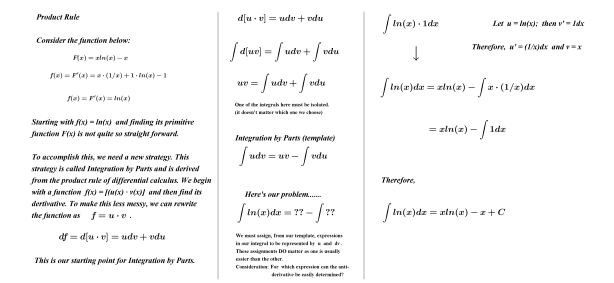
The process of Integration by Parts is essentially the inverse to the product rule from differential calculus. The example I’ve used here relates directly to this problem.

Integration by Parts


Thanks for reading.
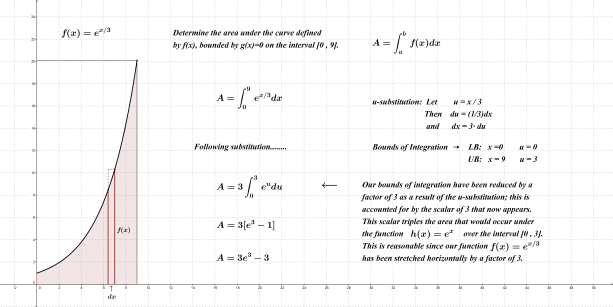
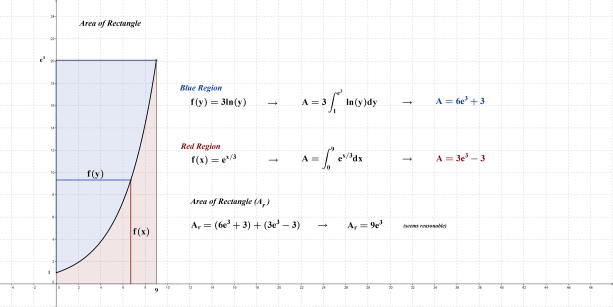
For the past week or so, we’ve been focused primarily on differential calculus and becoming comfortable with the rules that have been derived through the limiting process. The derivatives of e^x and ln(x) were both derived but only the anti-derivative of the former reveals itself through that process. Since the primitive of ln(x) remains a mystery, only the first part of the exploration below can be tackled.

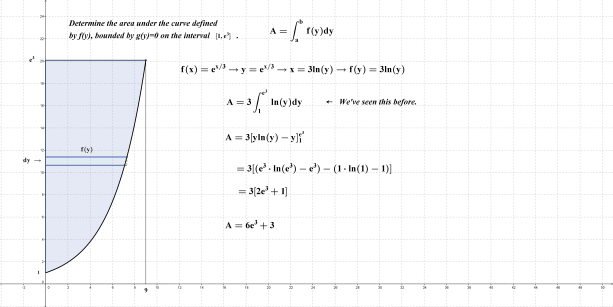
In order to facilitate completion of the entire sequence below, I will ask the students to determine the derivative of f(x)=-x+xln(x). The result will be very useful for our purposes here and will also launch us into Integration by Parts.

AreaUnder exp


AreaUnder exp2


AreaUnder exp3


Thanks for reading.
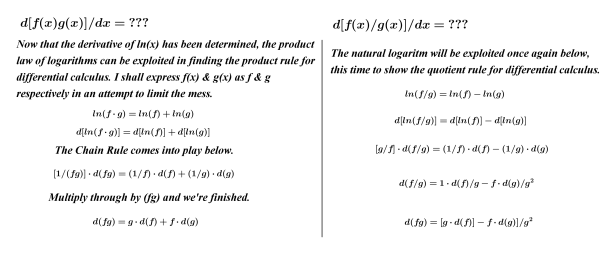
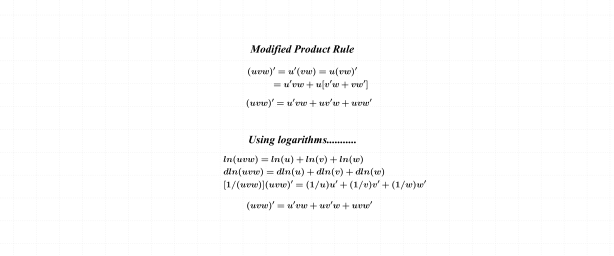
Having previously determined the derivative of ln(x), we now have that at our disposal to show one perspective of the product and quotient rules of differential calculus. A quick excursion to “implicit differentiation land” and a review of the chain rule will set things up nicely to meet our objectives here.

Implicit Diff and Chain Rule


Product and Quotient Rules

Product Quotient Rules

Modified Product Rule

Modified Product Rule

Thanks for reading.

Once students have a feel for calculating derivatives by limits of various functions, the same is done for ln(x) and e^x. Each of these show the importance of binomial expansion as that skill is once again necessary in understanding why things are as they are.

Derivative of ln(x)

Derivative(ln)

The derivative of ln(x) have many applications including logistic growth which we will see later this semester. We can, however, put this to work immediately by using it along with our knowledge of the product and quotient laws of logarithms. These are woven together nicely to determine the product and quotient rules of differential calculus.

The Euler constant “e” is also exploited in deriving the Rule of 72.


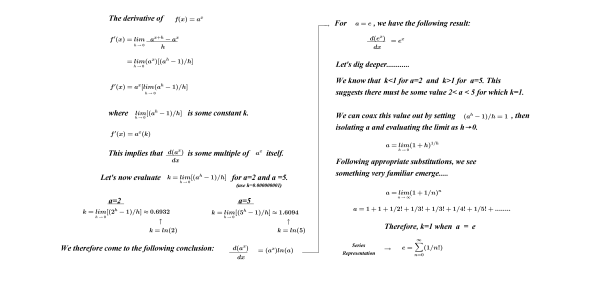
Derivative of e^x

Derivative(e^x)


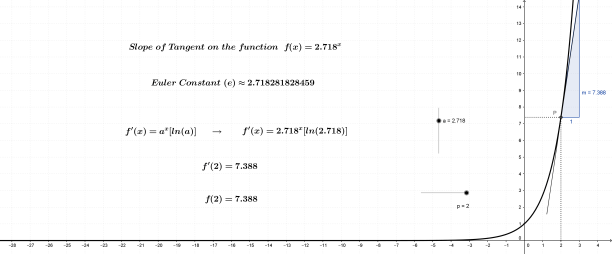
Geometric Perspective of d(a^x)/dx

Derivative Exponential Function

To interact with the function above, click on d(a^x)dx.

Click the link provided to see two additional perspectives on the derivative of e^x.


Thanks for reading.
 

Reference

Courant, Richard., John, Fritz (1999).  Introduction to Calculus and Analytics: Classics of Mathematics. New York, NY:  Springer-Verlag Berlin Heidelberg.

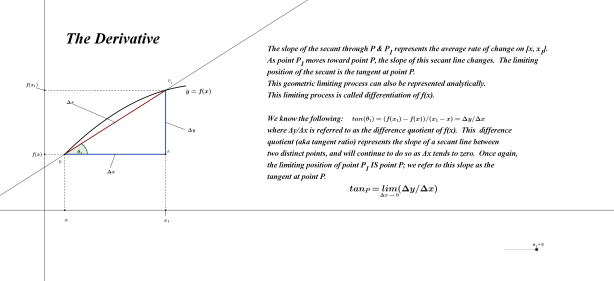
Yes, I prefer introducing integral calculus prior to differential for various reasons, one of which is that I believe that the former should not be dependent on the latter (my reasoning for this approach is very sound, in my opinion). The two disciplines are each introduced on their own merits with the inverse relationship between the two being discovered soon thereafter. These are my notes introducing differential calculus.

Derivative

Derivative2Derivative3


Click on secant line and adjust slider.

Thanks for looking.


Reference

Courant, Richard., John, Fritz (1999).  Introduction to Calculus and Analytics: Classics of Mathematics. New York, NY:  Springer-Verlag Berlin Heidelberg.

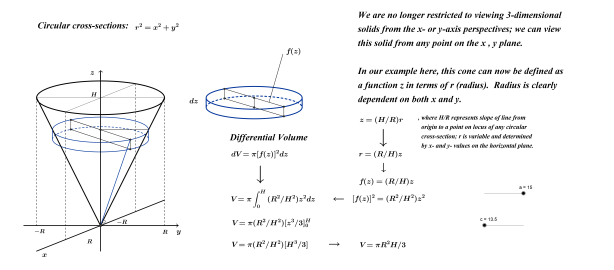
I’m snooping around multi-variable calculus with this entry. Presentation of this in class will depend on circumstances (time and where students are). I will nevertheless post a link to this on Google classroom and let students explore if they so desire.

Cone volume (multivariable)

Explore the volume of a cone from a different perspective.

Check out volume of pyramid as well.

Thanks for looking.